Availability
Are you available to take on contract work?
I am currently taking on a limited number of projects as a sole trader. Whether I have capacity depends on timing and project fit — get in touch through the contact page and we can find out.
What kind of work do you take on?
Product design and development projects — from early concept through to manufacturing. That includes full end-to-end engagements, joining projects mid-stream, design leadership and consultancy, and tooling and manufacturing coordination. If you're not sure whether your project fits, reach out through the contact page and we'll work it out.
Background
What kind of designer are you?
Industrial designer with a focus on physical products — things that get manufactured, distributed, and used. My work spans the full development cycle: brief, concept, CAD, prototyping, tooling, supplier coordination, and production handover. I can engage and hand off at any stage of that process.
How long have you been working in industrial design?
12 years of commercial practice, starting as an industrial designer at Rotadyne in March 2014 before becoming Head of Industrial Design and Product Development Manager. Alongside that I founded Design Centric Pty Ltd in 2016, which I ran concurrently before strategically winding it down when the opportunity to build something at greater scale at Rotadyne emerged.
What sectors have you worked across?
Defence and law enforcement, construction and infrastructure, utilities, retail, architecture, automotive, marine, wildlife and environmental conservation, and social impact. Good design principles are fundamental and universal — what changes between fields is the constraints, the regulatory environment, and the user context. I excel at learning those quickly and applying sound design thinking within them.
Strongest Expertise
What is your strongest area of expertise?
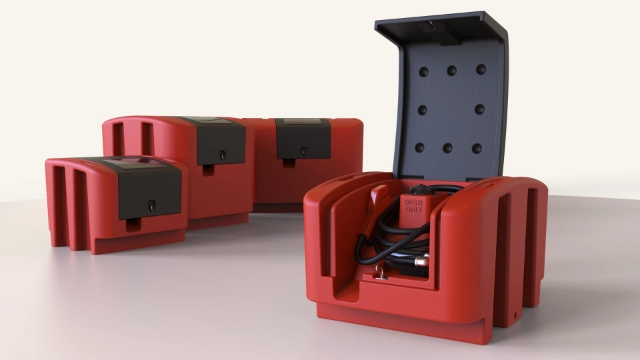
Rotational moulding, without question. I've spent 12 years designing exclusively for this process at a depth that goes well beyond aesthetics — into tooling geometry, material selection, wall thickness strategy, parting line placement, insert design, and the economic decisions that determine whether a product is viable to manufacture at a given volume. I understand the process from the designer's chair and from the factory floor, which means I can make better decisions earlier and avoid the costly late-stage discoveries that come from designing without that knowledge.
What does deep rotational moulding expertise actually change in practice?
It compresses the development cycle. When you understand the process constraints from the start, you don't design geometry that can't be demoulded, specify wall sections that won't fill uniformly, or place features that complicate tooling unnecessarily. That knowledge gets applied at the concept stage — not discovered during DFM review or, worse, during sampling. It also means I can have a productive technical conversation with toolmakers from day one, which keeps projects moving.
What makes rotational moulding different from other plastics processes?
Rotomoulding is a low-pressure, open-mould process where plastic powder is heated and rotated inside a mould until it coats the interior surface evenly, producing hollow, seamless parts in a single operation. Because the process doesn't rely on injection pressure, tooling costs are significantly lower than injection moulding — making it well-suited to larger parts, lower production volumes, and complex hollow geometries that would be impossible or prohibitively expensive to produce otherwise. The trade-offs are in dimensional precision, surface detail, and cycle time. Designing well for rotomoulding means understanding how material flows during rotation, how wall thickness is affected by geometry, where sink and warp risks arise, and how to detail features so they form cleanly without creating tooling complexity that adds cost or risk.
Manufacturing & Process
What manufacturing processes do you work with?
Rotational moulding is my deepest area of expertise, but my experience extends across a broad range of processes — injection moulding, steel fabrication, sheet metal, extrusion, timber, and rapid prototyping and production 3D printing. Each has its own geometric logic, economic threshold, and design constraints. I'm not a specialist in all of them to the same depth, but I understand their principles well enough to design appropriately for them and to work productively with the specialists and manufacturers who deliver them.
Do you have experience with offshore toolmaking and manufacturing?
Yes, extensive experience managing toolmaking and manufacturing relationships internationally — including across Asia and Europe, among others. That work includes specifying tooling requirements, reviewing and negotiating DFM feedback, managing sampling and approval cycles, and coordinating production handover. International manufacturing relationships require clear documentation, precise communication, and the patience to work across time zones, languages, and different manufacturing cultures. I've built those skills across multiple long-term client projects.
What does your prototyping process look like?
It depends entirely on what question needs to be answered. Early in a project I use digital prototyping for geometry, clearance, and assembly checks. For proportion and spatial relationships, physical scale models are often more useful than a screen. When ergonomics, reachability, or user interaction need to be validated, full-scale physical prototypes — whether foam, cardboard, timber, or fabricated — give feedback that digital models simply can't. At more refined stages, 3D printing covers fit checks through to surface and mechanism testing depending on the technology used. These are examples of the tools available; the right choice is always driven by what the project needs to learn at that moment.
Project Delivery
What does end-to-end project delivery mean in practice?
It means I own the project from first conversation through to production. That includes scoping and quoting the work, developing concepts, iterating through design development, producing detailed technical documentation, managing toolmakers and suppliers, and reviewing samples. It also means following through into manufacturing — attending or coordinating first article inspections, supporting first production runs, and driving design optimisations as they arise. Products rarely come out of tooling perfect; being involved through that stage is where a lot of the real value gets locked in.
Have you managed design teams?
Yes. At Rotadyne I built the design department from a sole practitioner to a team of four — hiring two industrial designers and a marketing designer. I managed workload allocation, professional development, technical mentoring, and output quality across concurrent projects. I also operated as the business development function after absorbing that role, handling client acquisition, proposals, contract negotiation, and project scoping.
What scale of projects have you delivered?
Individual projects have ranged from $20K to over $500K in value, varying from focused product updates completed in a matter of weeks to multi-year product range engagements. Some of the most substantial work has been the long-running relationships — with clients like Lomax and Britec, where I've delivered a continuous stream of additions and updates to the product range over many years, including location-specific variants developed for international markets.
How do you handle multiple concurrent projects?
With a clear view of which decisions are blocking which deliverables, and a preference for making those decisions fast rather than letting uncertainty accumulate. I use structured project management — Gantt-based scheduling, milestone tracking, and regular client touchpoints — but the real tool is knowing the work well enough to spot problems before they become delays.
Skills & Tools
What software do you work in?
SolidWorks for 3D CAD and technical documentation, which I use at an advanced level for complex surface work, assemblies, and manufacturing drawings. Adobe Creative Suite and Affinity Studio for presentation and visual communication. KeyShot for photorealistic product rendering. Blender for motion and concept visualisation. Monday.com for project management. I also develop in Android Studio — I'm currently building a mobile app — which gives me a level of digital product experience that industrial designers rarely have.
Do you work across the full visual communication pipeline?
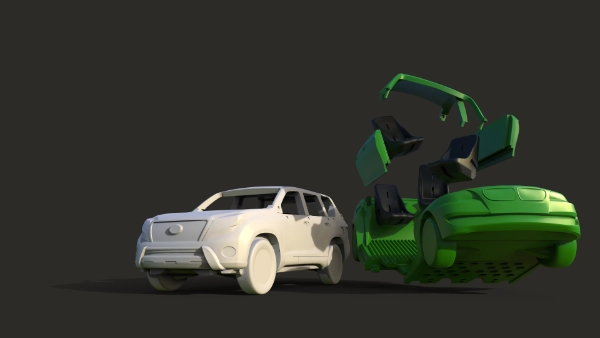
Yes. I produce technical drawings, photorealistic product renderings, exploded views, and product animations in-house. This matters because it keeps the communication of design intent consistent and reduces the gap between what a design means and what a client or manufacturer understands it to mean.
You mention ISO 9001 — what was your involvement?
I implemented the QMS processes required to achieve and maintain ISO 9001 compliance at Rotadyne, collaborating with clients and suppliers to meet international standards and evolving regulatory requirements. It's unglamorous work but it matters commercially — particularly for clients in defence, infrastructure, and regulated industries who require supplier certification.
Teaching & Research
You teach at university — what and where?
I developed and delivered the Design for the Circular Economy advanced unit at Western Sydney University from 2021 to 2025, for third-year engineering and architecture students. The unit embeds systems thinking, life cycle assessment, and sustainable design frameworks, and uses real projects I've led as case studies to ground the theory in manufacturing reality.
Did your teaching have any broader impact?
One project I created — an industry-collaborative circular-economy brief challenging students to repurpose real rotomoulding waste into park concepts for a live Sydney redevelopment — inspired the Association of Rotational Moulders Australasia (ARMA) to establish a national student design competition. That outcome extended the work beyond the classroom into the broader manufacturing sector, which was more than I expected from a single unit.
On the Work
What do you actually enjoy about this work?
The moment when a product that didn't exist becomes something physical that someone uses. Every step before that — the brief, the sketching, the CAD, the arguments with toolmakers, the samples that don't come back right — is in service of that outcome. I've spent 11 years finding that outcome consistently satisfying. I don't expect that to change.
Want to talk about a project or role?
Get in touch